Ask most people what happens to a building once the city puts a landmark plaque on it, and they'll tell you: nothing. It gets frozen. The paint colors get regulated, the windows can't change, and the building becomes a version of itself from whatever decade earned it the designation.
That is not what is happening to the building at the corner of Haight and Ashbury.
On September 17, San Francisco Heritage announced it has selected KEXP, the Seattle public radio station, and Blue Bear School of Music to turn the Doolan-Larson House into a working music and cultural center, complete with a rooftop performance venue and a broadcast booth looking out over Haight Street. The building is Landmark No. 253. It is also, by design, about to look and function nothing like it does today.
A Landmark That Was Gifted to Change
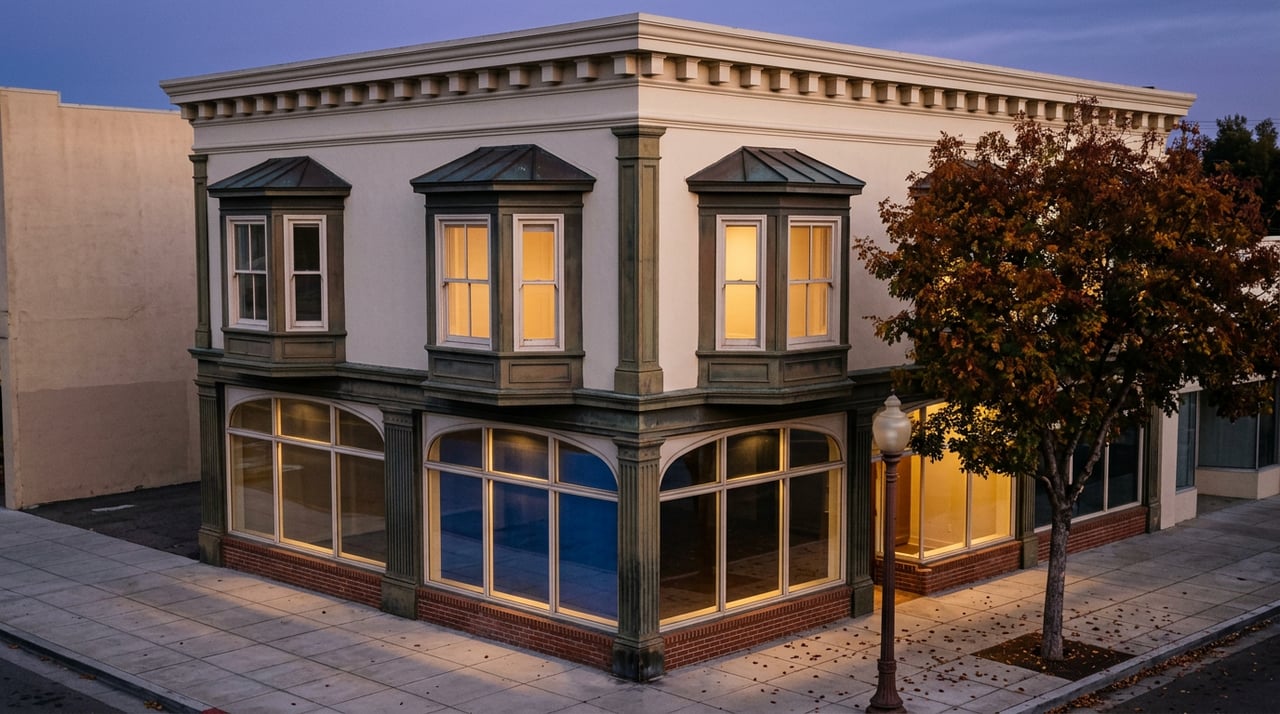
The Doolan-Larson House was built in 1903 for Richard Doolan and raised a story after the 1906 earthquake so the owner could add six small storefronts at street level. One of those storefronts became Mnasidika, one of the city's first hippie boutiques and a shop tied to the Grateful Dead and Janis Joplin. That history is why the building carries landmark status and a spot on the National Register of Historic Places.
But the reason the building is available to reinvent at all traces back to one decision. Longtime owner Norm Larson gave the property to San Francisco Heritage in 2017, and the gift came with an expectation, not a restriction: the building should stay active, not turn into a static museum piece. Heritage has run an artist-in-residence program there since the donation. That program ends now, as part of the new partnership.
The six ground-floor storefronts currently hold a mix of Haight-inspired gift shops, a salon, and a jewelry store. Those tenants will need somewhere else to go. San Francisco Heritage's executive director, Woody LaBounty, has said the organization will help them relocate. The building's mission continues even as its storefronts take on a new use.
What Three Teams Pitched For
This wasn't a single offer that Heritage accepted. Three separate teams submitted full adaptive reuse proposals for the building in June 2026. Heritage's board narrowed the field to KEXP's proposal as the sole finalist in August. The station's pitch centers on bringing a version of its Seattle model, a physical gathering space built around live music and radio, to what LaBounty has called the most famous intersection in the world.
KEXP is not new to the Bay Area. The station bought the broadcast license for 92.7 FM at a bankruptcy auction and began transmitting into Northern California in 2024. A permanent home at Haight and Ashbury would be the station's first physical location outside Seattle, where its existing facility took roughly $16 million to build a decade ago. KEXP expects this project to cost more.
What the Blueprint Actually Says
As the San Francisco Chronicle reported, the early architectural plans, drawn up by Gensler and historic preservation firm Page & Turnbull, sketch out a specific set of changes rather than a vague vision:
- A contemporary addition built above the three street-level retail spaces north of the main house, likely housing a rooftop venue for concerts and community events
- Three second-floor rooms preserved largely intact and converted into rehearsal spaces for Blue Bear School of Music, which has operated in San Francisco for more than 50 years and currently runs over 1,000 free music programs annually through underserved neighborhoods and the school district
- A broadcast booth on the second floor, positioned so DJs can see down onto Haight Street while on air
- The six existing ground-floor retail spaces consolidated into a single broadcast studio and performance area, similar to KEXP's setup in Seattle
None of this is finalized. San Francisco Heritage still has to work out the adaptive reuse agreement with KEXP and Blue Bear, gather community input, confirm construction feasibility, and secure Planning Commission approval before anything gets built. No opening date has been set.
"The thing that is important to us is that it's on the most famous intersection in the world, so we want to do it justice."
That's LaBounty, quoted by the San Francisco Chronicle, speaking about the importance of the site.
The Street Fair Was Planned as an Early Outreach Opportunity
The timing of the announcement was not incidental. The 47th annual Haight Ashbury Street Fair had been scheduled for September 20, from 11 a.m. to 5:30 p.m., with five blocks of Haight Street between Stanyan and Masonic closed for the event. Street closures were scheduled to start at 6 a.m., and Muni reroutes on the 7 Haight/Noriega, 33 Ashbury, 37 Corbett, and 43 Masonic were scheduled to last until 8 p.m.
KEXP and Blue Bear had planned to use the fair for their first public outreach on the project, setting up alongside the fair's usual mix of more than 200 vendors, three music stages, and the nonprofit organizations the event has supported since local merchants organized the first fair in 1978 with backing from then-Supervisor Harvey Milk.
The Corridor Already Runs on Reassignment
The building at Haight and Ashbury is the biggest example of a pattern that's been playing out at street level all year. This corridor doesn't tend to lose its landmarks outright. It reassigns them.
The clearest case is a few blocks over, where O'Reilly's now occupies the space that used to be Milk Bar, a longtime home for stand-up comedy that closed abruptly in 2024. The new owner, who has lived in San Francisco for 23 years, kept the space in the entertainment business but shifted the format: comics, live music, and trivia seven nights a week instead of a dedicated comedy club. The address didn't sit empty. It changed jobs.
Magnolia Brewing, founded in 1997, followed a similar logic from the ownership side. The brewpub is back under independent ownership rather than a corporate one, which is a different kind of reassignment: same building, same name, different hands running it.
Not every closure on the strip fits that pattern. Held Over Vintage, a fixture on Haight Street since 1976 and one of the last shops in the old Retro City Fashion thrift network, closed for good on May 30.
Otra, the upscale Mexican restaurant that has anchored a corner of Lower Haight since 2021, is closing its dining room in early December. Owners Nick and Anna Cobarruvias have pointed to an unusually slow summer that squeezed margins against high fixed costs, a pressure restaurants across the city have been dealing with this year. They've described the move as a pivot toward their salsa brand rather than an ending: unlike Held Over, the business survives in a different form, even if the storefront doesn't.
Line those four cases up next to the Doolan-Larson project and the shape of the neighborhood gets clearer. Ownership changes, formats change, and even the most protected building on the most photographed corner in the city is set up to change use entirely. What stays constant is that something keeps happening at these addresses. The Haight doesn't have many vacant storefronts sitting untouched for years. It has buildings that keep getting handed to whoever is willing to keep them active.
What This Actually Looks Like Over the Next Year
If you live near Haight and Ashbury, here's what to actually expect, based on where the project stands today. Nothing changes on the ground floor immediately. San Francisco Heritage still has to finalize terms with KEXP and Blue Bear, run a community input process, and clear Planning Commission review, all of which the organization has described as a coming-months timeline rather than a coming-weeks one. The current retail tenants will get help finding new locations before anything closes for construction. And the loudest version of this story, a rooftop full of live music at the corner of Haight and Ashbury, is still a proposal with a fundraising campaign ahead of it, not a scheduled opening.
What is certain is that the building isn't being mothballed. Whatever landmark status meant for the Doolan-Larson House, it was never going to mean silence.
If you're watching how central San Francisco neighborhoods like this one hold onto their character while everything at street level keeps turning over, that's exactly the kind of pattern worth understanding before you buy or sell here. Brendon Kearney tracks these shifts block by block across the city's central neighborhoods. Schedule a private consultation to talk through what a specific property or corridor's turnover history actually tells you about its next five years.
This article is general information, not legal, tax or financial advice. Consult a qualified professional about your situation.