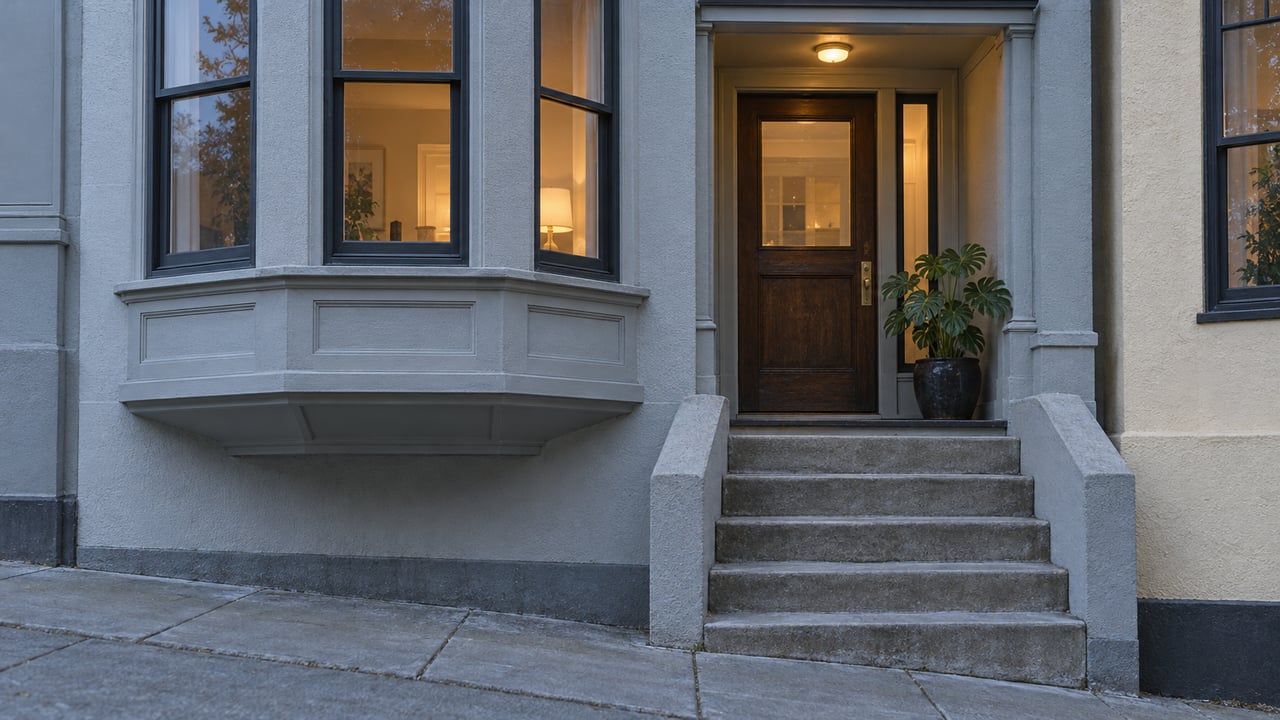
On July 4, people walked into the Fillmore Heritage Center carrying lawn chairs. KQED's account of that weekend noted that "you don't bring a lawn chair to a ribbon-cutting. You bring one to a place you intend to stay a while." A sound healing session, a film screening and a fireside chat ran at the same time inside the building, and Ace Washington, the corridor's longtime ambassador, moved between the lobby and the street.
The same report also made clear what that weekend was not. It was not a permanent reopening. It started a temporary activation period that runs through December.
The rest of the lower Fillmore, roughly Geary down to McAllister, is running the same way in 2026. A night market series sets four dates across the year. A to-go drinks zone only switches on when the street closes to cars. If you live within walking distance, the best version of this corridor this fall is on a calendar, and the permanent businesses carry the nights in between.
A landmark building with a monthly cap
The Heritage Center at 1300 Fillmore opened in 2007. KQED puts the cost of the complex at more than $80 million. Yoshi's San Francisco filed for bankruptcy reorganization in 2012 and closed in 2014. Its replacement, The Addition, closed within months. 1300 on Fillmore, the last tenant still operating there, was gone by 2017. For most of the years since, the building sat closed on a block that otherwise stays busy.
On May 28, the City announced temporary activations at the center, along with a facility assessment and a market study. Applications for community programmers were set to open at the end of June. According to KQED, the Office of Economic and Workforce Development is preparing a formal application process for one-day public events. It allows up to eight activations a month through December, and programming is limited to the lobby, the screening room and the gallery while the City assesses the building's condition. By the end of the calendar year, staff are expected to turn that work and community input into options for the building's next steps.
Eight days a month at most, in three rooms, for a set period. That makes the building one of the corridor's scheduled windows. The groups that have shaped its programs so far are local. Fillmore Rising, a collective co-led by Majeid Crawford of the New Community Leadership Foundation and Ericka Scott of Honey Art Studio, developed its ideas in weekly community mapping sessions at Third Baptist Church. Those ideas include a curated gallery, an African diaspora restaurant, a 39-seat screening room for independent film and youth programming, and sliding-scale rentals for local event organizers. Linda Parker Pennington, an early investor in Yoshi's, organized the July 4 Dream Center weekend of wellness workshops, art, youth media, a genealogy workshop and a documentary screening.
We have not found a published October through December event calendar for the building. The practical approach is to check each month and treat any open day as limited.
The night market sets four dates
The City planned Fillmore After Dark as a yearlong series. The Office of Economic and Workforce Development and Livable City organize it with support from the Civic Joy Fund, and the plan calls for local vendors, arts and cultural performances, and programming tied to the neighborhood's history. The 2026 schedule so far:
- Friday, May 22. The series launched.
- Friday, August 21. "Hot August Night" featured classic cars, local vendors, food trucks and live entertainment.
- Saturday, October 31. The Kids Scream Zone and Halloween night market.
- Friday, December 11. The holiday night market.
The Halloween edition runs from 4 to 9 p.m. at O'Farrell and Fillmore and the adjacent Safeway plaza. Livable City's event page lists the following:
- Trunk-or-treat with vintage classic cars and spooky mini-houses in a dedicated kids' zone
- Live music, performances and youth dance showcases
- A costume contest with categories for Scariest Monster, Most Creative, Best Duo and Family Group Looks
- A food and merchant bazaar with street food pop-ups and local makers
- Live bingo inside brick-and-mortar shops, plus a Fillmore Business Tour along the corridor
The event is free, and the organizers ask attendees to RSVP through the listing.
The bingo and the business crawl are designed to pull people off the plaza and into the storefronts. In practice, the night market works as a scheduled introduction to the shops that are open the rest of the month. The December 11 holiday market follows the same pattern. It runs from 4 to 9 p.m., with bingo from 4 to 7 and the market from 5 to 9, plus local vendors, food, drinks, music and another business crawl.
The drinks rule turns on only when the street closes
The third scheduled window is a legal one. On December 2, 2025, the Board of Supervisors approved the Lower Fillmore Entertainment Zone. It covers Fillmore Street from Sutter to McAllister and one block of O'Farrell from Steiner to Fillmore. As SFist explained, a to-go drink can leave a participating business but cannot leave the zone, and the privilege applies only during events when the streets are closed to cars.
The zone was used at the Fillmore Jazz Festival on July 4 and 5, which ran on Fillmore from Jackson to Eddy with more than 30 performances on five stages. We found no confirmation that it will be active for the October 31 market. It is safest to assume the Halloween edition is a family event with no to-go drinks unless the organizers announce otherwise.
The zone differs from the other two windows in one way. It has no dates of its own and only applies when an event has already closed the street.
What holds the street between dates
The permanent anchors are what make the scheduled nights worth repeating. A short list for the other weeknights:
Sheba Piano Lounge, 1419 Fillmore. Owners Israel and Net Alemayehu run Sheba as an Ethiopian kitchen with live music Wednesday through Sunday. It is the most reliable unscheduled night on the corridor.
Minnie Bell's Soul Movement. Chef-owner Fernay McPherson also serves on the Fillmore Community Action Plan committee. She told KQED, "I'm not going to say what was here, because we're still here."
In the Black, 1567 Fillmore. Axios reported in March that this Black-led marketplace was carrying about 20 vendors and hosting monthly events, workshops, live music and artist showcases.
Tacos El Patrón, 1325 Fillmore. This is the corridor's newest opening. It took over the space that previously held Black Bark BBQ and then Scott's Chowder House. Owner Alberto Pineda told The New Fillmore in August, "There are no tacos around." It is his third location, after Pleasant Hill and the Mission, and his largest, with about 50 seats. The menu covers tacos, burritos, tamales and guisados, the slow-cooked stews that are one of the restaurant's specialties. By early September, The New Fillmore reported that it had opened, and 48 Hills named it an editor's pick in its Best of the Bay 2026 issue at the end of the month.
Separately, the City awarded $230,000 in SF Thrives grants to 23 Western Addition businesses. It also gave West Bay Community Center a Storefront Opportunity Grant to run a neighborhood commercial-kitchen program with the New Community Leadership Foundation. That money goes to the businesses open between the scheduled dates.
The Sutter edge fills in, and groceries remain the open question
North of Geary, where the corridor meets Japantown, the changes so far are smaller and permanent. Restaurateur Kevin Chen, who already runs Don Don, Ninniku and Nono Baru, opened Yuzu on Sutter near Fillmore. It is a takeout counter and grocery during the day. In the evening, behind a refrigerator door, it serves a 12-course omakase for $65 at a 10-seat counter. Chen told The New Fillmore the goal is "a very affordable omakase dining experience with a very fun casual setting." As of early September, he was also soft-opening Avocado Green, a tea and coffee shop in the windows of the Nono Baru space at 1800 Fillmore.
Across the intersection, the former Pride of the Mediterranean space at Fillmore and Sutter is becoming Matdol Tofu. It comes from Jiman Jang and the team behind the San Jose food truck Jevikal. The menu centers on handmade tofu, with sundubu jjigae, L.A. galbi and buckwheat noodles with perilla oil, and the team is aiming to open in December or January. Jang pointed to the Gongnip Association, a group for newly arrived Koreans that moved its headquarters to 1944 Buchanan Street in 1908, as part of why the location matters to the team. Until a door opens, treat that date as a target.
Groceries are the everyday gap. The Webster Street Safeway has closed and the Lucky on Fulton is preparing to close. According to The New Fillmore, about 75 people met at the African American Art & Culture Complex to explore a community-owned grocery store, led by neighborhood resident Emma Dolan. The group is studying Rainbow Grocery and Oakland's Mandela Grocery Cooperative as models. District 5 Supervisor Bilal Mahmood is working on planning and zoning changes through his Affordable Groceries Act that are meant to make it easier to open new grocery stores across the city. A few blocks north, Hello Mart was scheduled to open September 12 at 2135 Buchanan with groceries, bento boxes and a coffee bar.
The next two fixed dates are Saturday, October 31, 4 to 9 p.m. at O'Farrell and Fillmore, and Friday, December 11, also 4 to 9 p.m. By the end of December, the City is also due to lay out options for the Heritage Center's long-term future.
If you own near the lower Fillmore and want to talk through how the Heritage Center decision and the new openings fit into plans for your property, Brendon Kearney can walk you through it. Schedule a private consultation.
This article is general information, not legal, tax or financial advice. Consult a qualified professional about your situation.